
Buyer’s guide
How to buy a plug-in solar kit
Plug-in solar can be a smart small upgrade for an apartment, patio, balcony, or sunny yard.
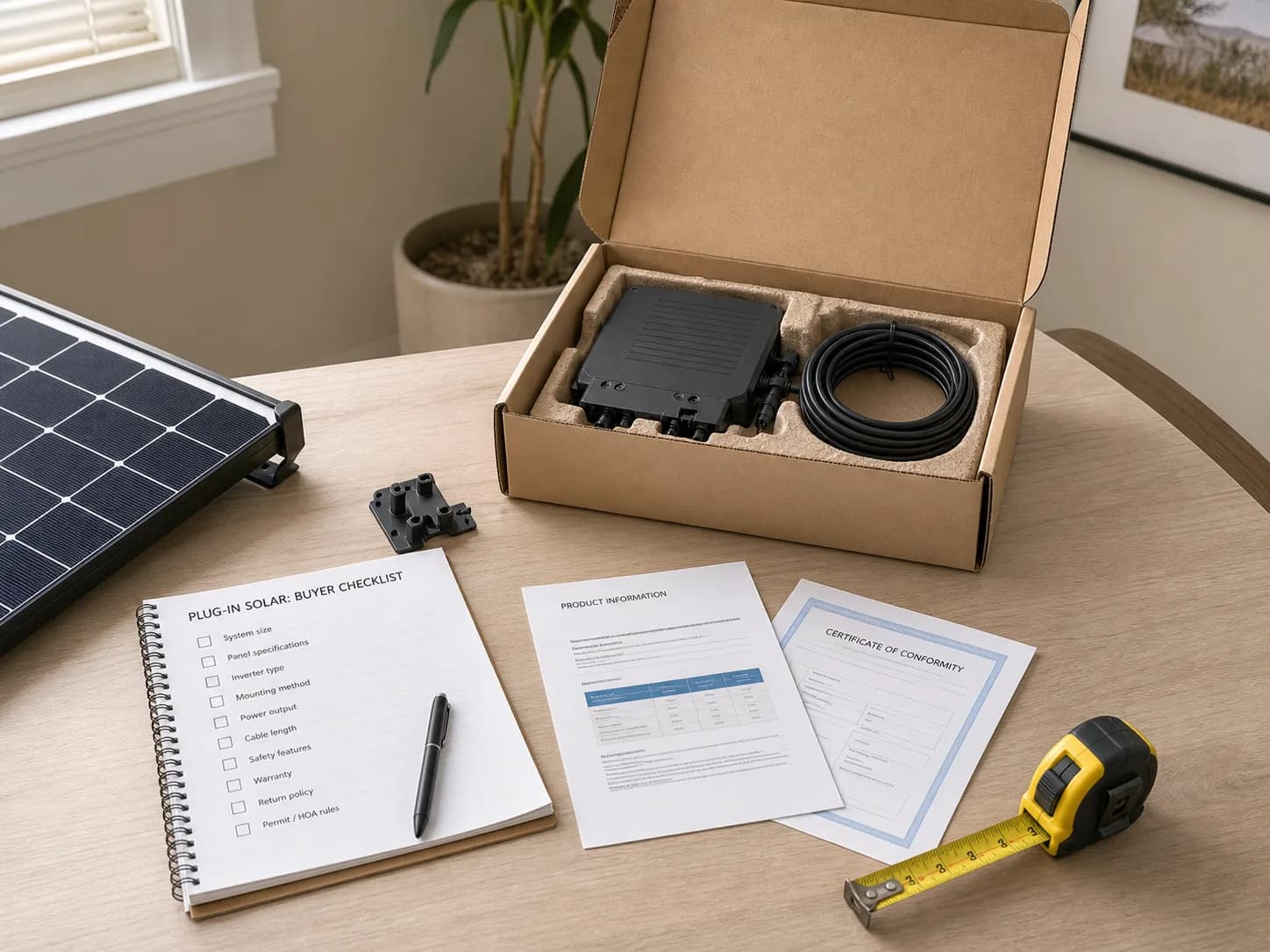
1. Check your state first
Start with the state tracker and find your state. If a bill is pending, awaiting a governor, deferred, or failed — or if no dedicated statewide law was found — don’t treat that status as permission to install. An enacted framework may also have a future or phased effective date.
And read the details, not just the colored badge. Look for when the law actually takes effect, the maximum size allowed, whether you need to notify your utility, and whether your local building and fire codes, landlord, or homeowners association (HOA) still have a say. A supportive state law rarely overrides all of those on its own.
2. Check that the whole system is certified
This is the check that protects you most. You’re looking for proof that the complete kit — not just one part — has been tested and certified for plugging solar into a home. The U.S. standard written for that is UL 3700, tested by an independent safety lab like UL.
Strong, trustworthy language names the lab, the exact product or model, how it’s meant to be installed, and everything it covers — including the plug, the outlet, and any battery. Weak language leans on vague phrases like “UL components,” “designed to UL standards,” “certification pending,” or “meets code” with nothing you can actually look up. When in doubt, ask the seller for the certificate and check the lab’s public database.
- Ask which standard the complete plug-in PV system is certified to.
- Ask which testing lab issued the certification and where to verify it.
- Ask whether the listing covers the plug, receptacle requirements, inverter, meter or zero-export control, battery, and exact installation mode.
- Treat “UL 1741 inverter” as useful but incomplete. It does not prove the whole plug-in kit is certified for plugging into your home.
3. Make sure you have a safe, sunny spot
A great kit in a bad spot is a bad buy. You want real sunlight — ideally facing south with little shade between mid-morning and mid-afternoon — and a mount that can hold the panels through wind and weather.
Here’s the catch people miss: certifying the electronics says nothing about whether your railing, wall, or patio frame can safely carry a panel. Check that your mounting surface is strong enough and allowed, that nothing below could be hit by a falling panel, and that cables are protected from pinching, water, and foot traffic — and that the gear is actually rated for the outdoor spot you have in mind.
South, southeast, or southwest-facing panels with little shade between 10 a.m. and 4 p.m., mounted securely on a patio, yard frame, wall, or allowed balcony rail.
North-facing balconies, recessed balconies shaded by the unit above, heavy tree shade, or panels hanging over sidewalks, driveways, public space, or a neighbor’s patio.
4. Size the system from your real daytime use
Don’t size a plug-in kit from your annual electric bill alone. Size it from the electricity your home normally uses while the sun is out, plus what your utility will pay for any exported power. If surplus electricity earns little or nothing, a kit that is too large can pay back slower than a smaller one.
Good starter range for a small apartment, tight balcony, router, fridge cycling, standby loads, or uncertain daytime use.
Likely sweet spot for many homes with daytime computers, fans, networking, refrigeration, or part-time cooling load.
Better for high rates, strong sun, work-from-home load, daytime cooling, smart scheduling, zero-export control, or a battery.
Often outside simplified plug-in rules. Treat it like a different class unless your state law clearly allows it.
A simple estimate is: system kW × sun hours × 365 × performance factor × usable energy. With 4 sun hours, 80% performance, 85% usable energy, and an 18.83 cents/kWh rate, a 400 W kit is roughly $75/year, 800 W is roughly $150/year, and 1,200 W is roughly $224/year. At 30 cents/kWh, the 800 W example rises to about $238/year.
5. Compare the major offering types
The U.S. market is young, and product pages mix real engineering with optimistic marketing. Compare categories first, then sellers.
Usually cheapest and simplest. Best when you have steady daytime load and don’t need storage.
Uses a meter or control device to avoid sending power to the grid. Verify that the control is part of the listed system.
Stores surplus for evening use and may power plugged-in devices during outages. Higher cost, more complexity.
Can lower markup and build policy momentum. Product specs and certification still need the same scrutiny.
| Seller/platform | What it is | Price signal | What to watch |
|---|---|---|---|
| EcoFlow STREAM | Battery-integrated plug-in system with storage, app controls, and limited appliance backup. EcoFlow currently warns that U.S. plug-in installation is permitted in Utah and buyers should check local rules. | $1,279 STREAM Ultra; $1,599 Ultra + Microinverter on the checked page, before every possible panel bundle. | Polished storage-first option, but higher cost and not directly comparable to panel-only kits. |
| CraftStrom | Premium zero-export-style kits with panels, smart inverters, power meter, mounting, cables, and app. | $3,048 for a 1,200 W kit on the checked page. | Strong complete-kit framing, but verify complete-system listing and broad permission-free claims. |
| APsystems EZ1 ecosystem | Plug-in microinverter platform sold directly and through kit sellers such as US Solar Supplier, NAZ, Green Box, and others. | $325 EZ1 microinverter; $90 APmeter; $969 checked 810 W US Solar Supplier kit. | Likely low-cost backbone for many kits, but a microinverter or distributor bundle still needs product-specific certification review. |
| PluggedSolar | Simple panel-plus-microinverter kits with selectable panel counts and mounting options. | Base product from $699; checked 800 W configurations around $1,449-$1,599. | Accessible ecommerce option, but UL 1741 inverter language is not the same as whole-system UL 3700 certification. |
| Bright Saver | Nonprofit membership and group-buy model focused on low-cost balcony/backyard solar and state-law advocacy. | $29 membership unlocks at-cost pricing; final kit specs and pricing should be verified at checkout. | Good access mission, but buyers still need exact product specs, availability, instructions, and certification proof. |
Prices and availability were checked July 2026 and can change quickly. This is a market map, not an endorsement or ranking.
6. Decide whether a battery is worth paying for
A battery can make sense if you are away during sunny hours, have expensive evening time-of-use rates, get no credit for export, or want limited power for devices plugged directly into the unit during an outage.
It is harder to justify if your home already uses most solar production during the day, your rate is low and flat, or the battery doubles the cost. And be precise about backup claims: most grid-tied systems must stop feeding the home/grid during an outage. A battery only helps if the product has a listed backup mode, usually through specific outlets or a clearly isolated setup.
7. Run the numbers honestly
Use the savings calculator with your real electricity rate, an honest guess at your sun, and the total cost: product, panels, mounting, shipping, tax, smart meter or zero-export parts, battery, membership fee, and any required electrician or outlet work. Treat the result as an estimate to sanity-check the purchase, not a guarantee.
EnergySage puts many 400-800 W balcony systems around $500-$1,500, while Solar United Neighbors says today’s average payback is around five years and expects costs to fall if more states legalize the category. Your result may be better or worse depending on rate, shade, orientation, self-consumption, product cost, and whether export is credited.
Buy, pause, or walk away
- State law is effective or clearly allows the device.
- Complete-system certification is verifiable.
- You have a secure sunny spot and meaningful daytime load.
- Payback still works under conservative assumptions.
- The law is passed but not effective yet.
- Certification is pending or only component-level.
- Your balcony is vertical, shaded, or wind-exposed.
- A battery is included mainly for savings on a low flat rate.
- Your state, utility, landlord, HOA, or AHJ says no.
- The seller will not share instructions or certification details.
- The kit exceeds your state’s watt limit.
- The setup depends on an extension cord through a window or door.
Red flags to walk away from
Be wary of a product page that claims the kit “works in every state,” “needs no utility approval anywhere,” or plugs into “any outlet.” Be just as wary of one that promises it’ll power your home during a blackout without explaining a certified backup mode, or calls itself certified when only the inverter carries a mark.
Also pause if the seller won’t share the installation manual before you buy, shows photos of extension cords run through windows, sells a kit bigger than your state’s size limit, or pictures panels balanced on flimsy railings with cables dangling. Good sellers are happy to show you the details.
Sources
- UL Solutions Debuts Testing and Certification Framework for Safer Plug-In Solar Across the United StatesUL Solutions; accessed 2026-07-02
- UL 3700 Outline of Investigation for Interactive Plug-In Photovoltaic Equipment and SystemsUL Standards & Engagement; accessed 2026-07-02
- Current List of NRTLsOccupational Safety and Health Administration; accessed 2026-07-02
- What to know about plug-in solarSolar United Neighbors; accessed 2026-07-02
- Solar, minus the red tape: plug-in solar could bring affordable energy to millionsSolar United Neighbors; accessed 2026-07-02
- Plug-In & Balcony Solar Panels: Are They Worth It?EnergySage; accessed 2026-07-05
- STREAM Series Plug-and-Play Home Solar SystemEcoFlow; accessed 2026-07-05
- 1200 Watt Plug&Play SolarCraftStrom; accessed 2026-07-05
- EZ1 - ConsumersAPsystems USA; accessed 2026-07-05
- 810W Plug In Solar Kit with APsystems EZ1 MicroinverterUS Solar Supplier; accessed 2026-07-05
- Plug and Play SolarPluggedSolar; accessed 2026-07-05
- Plug-In Solar Panels for HomeBright Saver; accessed 2026-07-05